AIFMD Liquidity Stress Testing Requirements: Complete Guide
AIFMD II's liquidity management tool rules are now in force, with the core selection requirement applying to every open-ended fund — new and existing — from April 16, 2026. Here's what AIFMD actually requires for liquidity stress testing, what's changed, and why your LST methodology now feeds directly into a binding compliance decision.
AIFMD liquidity stress testing requires fund managers of open-ended AIFs to test, at minimum annually, how long it would take to liquidate a fund's assets under stress and how investors might behave under redemption pressure — an obligation that has applied since ESMA's 2020 guidelines, and now feeds directly into a separate, binding requirement: selecting at least two liquidity management tools for every open-ended fund. That second requirement, introduced by AIFMD II, applies to every open-ended AIF and UCITS fund — new or existing — from April 16, 2026. Here's what AIFMD actually requires for liquidity stress testing, what AIFMD II adds on top, and what fund managers should be doing now.
The baseline: liquidity stress testing has been mandatory for years
Liquidity stress testing (LST) under AIFMD isn't new. ESMA's Guidelines on Liquidity Stress Testing in UCITS and AIFs have applied since September 30, 2020, supplementing the liquidity risk management obligations already written into the AIFMD itself.
The minimum legal requirement under AIFMD is to perform liquidity stress testing annually. ESMA's guidelines go further, recommending a quarterly frequency as good practice, while acknowledging that some funds will need to test more or less often depending on their risk profile.
Liquidity stress testing under these guidelines covers both sides of a fund's balance sheet:
Asset-side testing estimates how long it would take to liquidate fund assets, and at what cost, under both normal and stressed market conditions — explicitly not relying solely on historical observations of stressed markets.
Liability-side testing models redemption pressure: how investors might behave under stress, accounting for the fund's investor base, distribution policy, and redemption terms.
Combined testing brings the two together, since a fund's actual liquidity risk depends on the interaction between what it holds and who holds shares in it.
This baseline obligation has applied to every AIFM managing an open-ended AIF for several years. AIFMD II does not replace it — it builds a new structural requirement on top of it.
What AIFMD II adds
AIFMD II (Directive (EU) 2024/927) required Member States to transpose new rules into national law by April 16, 2026, introducing mandatory liquidity management tools (LMTs) for open-ended AIFs and UCITS funds.
The core new requirement: fund managers must select at least two liquidity management tools for each open-ended fund they manage, from the harmonised list in Annex V of AIFMD, and incorporate them into the fund's constitutional documents. For money market funds, one LMT is sufficient. This selection obligation applies to every open-ended AIF and UCITS fund — regardless of when the fund was constituted — from April 16, 2026. There is no grandfathering on the selection requirement itself.
Available LMTs include redemption gates, redemption fees, swing pricing, dual pricing, anti-dilution levies, notice periods, and other mechanisms designed to manage liquidity stress without forcing fire-sale asset disposals. ESMA recommends selecting at least one quantitative-based LMT and at least one anti-dilution tool, although this specific combination is a recommendation rather than a hard legal requirement.
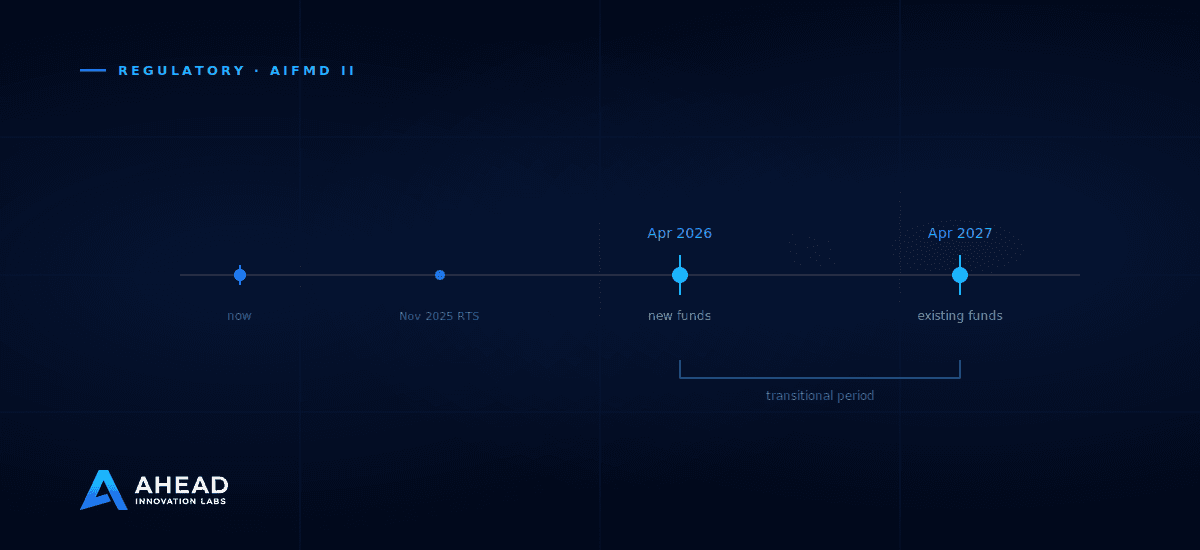
In November 2025, the European Commission adopted Delegated Regulations specifying the operational characteristics, activation thresholds, and calculation methodologies for these tools, based on draft RTS developed by ESMA. ESMA followed with final guidelines in March 2026 on how LMTs should be selected, calibrated, activated, and deactivated in practice. These detailed technical standards and guidelines — not the basic selection requirement — are what carry the transitional period described below.
Liquidity stress testing results are now an explicit input into LMT selection. ESMA's guidance instructs managers to consider, among other factors, the results of liquidity stress testing, the fund's investor base, its distribution policy, and any operational barriers to implementation when choosing which LMTs to adopt. Liquidity stress testing is no longer just a standalone risk management exercise — it now directly informs a binding structural decision about which tools sit in the fund's governing documents.
Who is in scope, and by when
The rules apply to AIFMs managing open-ended AIFs, with the obligation generally following the manager rather than just the fund's domicile. ESMA has clarified that the requirement extends to non-EU AIFs managed by an EU AIFM, not only to EU-domiciled funds.
There are two separate deadlines here, and conflating them is the most common mistake in how managers read this framework:
The core selection requirement — April 16, 2026, for every open-ended fund. Every AIFM managing an open-ended AIF, whether the fund was constituted before or after this date, must have selected at least two LMTs from the harmonised list and incorporated them into the fund's constitutional documents and governing policies by this date. There is no extension on this for existing funds.
The detailed RTS characteristics and ESMA guidelines — April 16, 2027, for funds constituted before April 16, 2026. The granular requirements — how each selected LMT operates, its activation thresholds, and the calculation methodologies set out in the Commission's Delegated Regulations and ESMA's guidelines — carry a 12-month transitional period for pre-existing funds. New funds constituted on or after April 16, 2026 must comply with this detailed layer immediately, alongside the basic selection requirement.
In short: every existing fund needed its LMT selection and core policy in place by April 16, 2026. The extra year to 2027 is for finalising the operational mechanics of those tools — not for deciding whether to have them. Fund managers should confirm the specific transposition approach taken in their own jurisdiction, since AIFMD II is implemented through national legislation and some local regulators have layered additional procedural requirements — such as specific notification formats — on top of the EU-level framework.
What fund managers should be doing now
A reasonable, generic preparation sequence — adapted from the kind of phased approach several advisory firms have recommended to clients — looks like this:
Assess each fund's liquidity profile against the LMTs it currently has (or doesn't have) in place.
Select compliant LMTs aligned with each fund's strategy, investor base, and the activation thresholds set out in the Delegated Regulations — this selection should already be documented for every existing fund, not just new ones.
Update constitutional documents and policies, with particular attention to documenting the reasoning that ties the selected LMTs to the fund's liquidity profile — several national regulators have indicated they expect this reasoning to be explicit, not just the tool selection itself.
Notify the relevant national competent authority of the selected LMTs and the associated activation and deactivation procedures, in the format required locally.
Test operationally with administrators, depositaries, and distributors to confirm the chosen LMTs can actually be executed when triggered — this is where several practitioners report the most friction emerging in practice, and where the 2027 transitional window for existing funds gives genuine breathing room.
Prepare governance and training for whoever is responsible for approving LMT activation and deactivation decisions.
Where this connects to liquidity stress testing methodology
AIFMD II's LMT requirements raise the stakes on getting liquidity stress testing right, because LST results now feed directly into a binding governance decision rather than sitting in a risk report that gets filed away.
ESMA's existing LST guidelines already push managers away from relying solely on historical observations of stressed markets when estimating liquidation costs and timelines. The guidance is explicit that managers should reflect a significant number and variety of market stresses in their estimates — not just replay the stress episodes that happen to be in the historical record.
This is a genuinely difficult instruction to satisfy with conventional methods alone. Historical liquidity stress events — March 2020, the 2008 crisis, various emerging market currency crises — are well documented, but they are also a small and non-representative sample of the liquidity stresses a fund could plausibly face. A fund whose LST methodology only replays known historical episodes is testing the handful of stresses that happen to have occurred, which is a narrower exercise than the "significant number and variety" the guidance asks for.
To be clear: ESMA does not mandate any specific methodology for generating that variety of scenarios, and forward-looking, AI-generated scenario analysis is not a stated regulatory requirement. It is, in our view, one credible way of more fully satisfying an instruction the guidance already gives — generating novel, plausible stress scenarios that go beyond what historical replay alone can offer, without replacing the historical analysis that remains a sound and necessary baseline.
What to do this quarter
Confirm your LMT selection and constitutional documentation are in place for every open-ended fund you manage — this applies regardless of when the fund was constituted, and there is no extension on this specific requirement.
Separately, confirm which transitional deadline applies for the detailed RTS characteristics: new funds comply immediately; funds constituted before April 16, 2026 have until April 16, 2027 — but shouldn't wait until then to start the operational work.
Review your existing LST methodology against ESMA's instruction to reflect a variety of market stresses, not just historical replay.
Map your LST output directly to your LMT selection rationale — regulators are likely to expect a documented link between the two now that ESMA's guidance treats LST results as an explicit input to LMT choice.
Engage your depositary and administrator early on operational testing — LMT activation mechanics that look fine on paper can surface friction in practice.
Check your local transposition — AIFMD II is implemented through national law, and some regulators have added jurisdiction-specific notification or documentation requirements on top of the EU baseline.