Benefits of Synthetic Data in Finance: Enhancing Model Reliability and Trading Strategies with Ahead Innovation Labs
Financial models fail because history is a single, finite sample — and the events that matter most are the rarest. Synthetic data escapes that limit, letting teams build more robust models and stress-test strategies against scenarios the market never produced. Here are the real benefits, and the honest limits worth knowing.
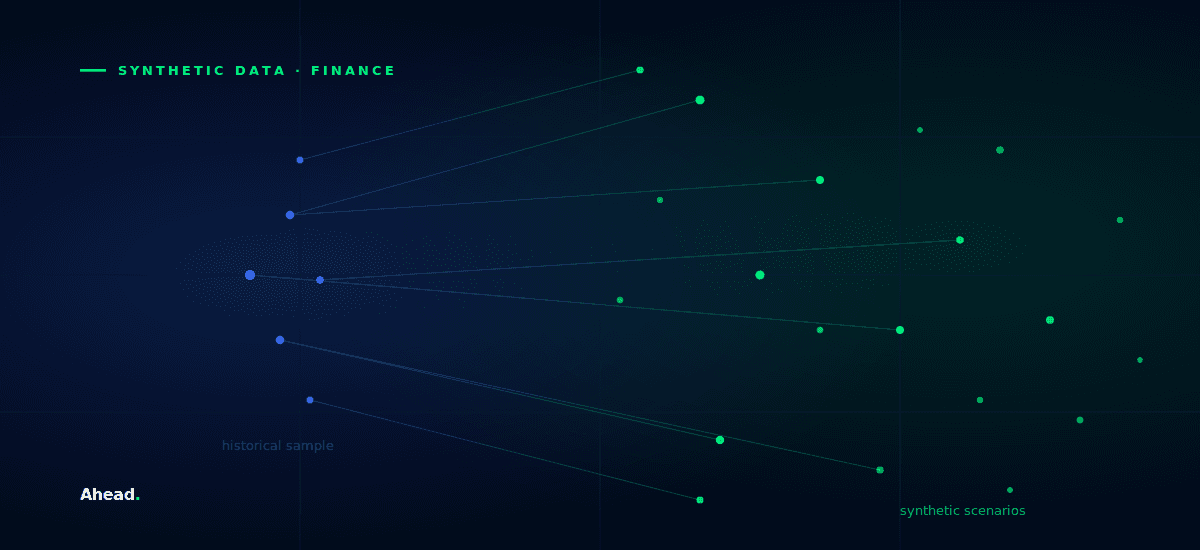
Synthetic data in finance is artificially generated market data — price paths, correlations, and volatility regimes produced by a model rather than observed in the market. Its central benefit is that it removes finance's most stubborn constraint: there is only one history, it is finite, and the events that matter most for risk are the ones that have barely happened. Synthetic data lets a quant team train and test models against a far wider range of conditions than the historical record contains, which in turn makes those models more robust, better at generalizing, and less likely to fail when markets do something they have not done before.
This guide walks through the concrete benefits, where each one genuinely applies, and the limits worth keeping in mind. (For a deeper look at how the underlying models work, see our companion article on generative AI in quantitative trading.)
The core problem synthetic data solves
Every historical dataset is a single realized path through a much larger space of things that could have happened. Markets have produced only one 2008, one March 2020, one 2022 rate shock — and a model tuned to that single path can look excellent in backtesting while remaining fragile to everything the path did not include. Worse, the most decision-relevant events are the rarest, so they are precisely the ones a historical sample under-represents.
Synthetic data attacks this at the root. Rather than being limited to what markets happened to do, a team can generate large volumes of plausible-but-unobserved data and use it to pressure-test models against conditions history is too small to supply. The benefits below all flow from that single shift.
Benefit 1: More robust models through richer training data
Machine learning models improve with more diverse, representative training data — and financial data is chronically short of both. Synthetic data augments a limited historical dataset with additional plausible scenarios, giving models a broader base to learn from. The practical payoff is better generalization: a model trained across many varied conditions is more likely to hold up on new, unseen data than one that has only ever seen a narrow historical slice.
This connects directly to overfitting, one of the central failure modes in quantitative finance. A model that trains on a small dataset tends to memorize its idiosyncrasies — noise, one-off events, sample-specific quirks — rather than learning the general structure underneath. By widening and diversifying the training set, synthetic data pushes a model toward learning patterns that persist rather than patterns that merely happened once.
A caveat matters here, and finance makes it sharper than other fields. In domains like image or text recognition, more augmented data is broadly helpful. In finance it is not automatically so: research on synthetic augmentation finds that quality and targeting matter far more than quantity, and that aggressive or poorly-calibrated augmentation can actively degrade a model rather than improve it. The reason is structural — financial data has a limited effective sample size, heavy tails, and a data-generating process that shifts as markets adapt, so synthetic data that drifts from the conditions that matter at evaluation can bias a model even as it appears to reduce error. The benefit is real, but it comes from representative diversity that reflects genuine market structure — not from volume for its own sake, and not as a substitute for sound model design.
Benefit 2: Stress testing against scenarios history never produced
This is the benefit most specific to risk management, and the one where synthetic data has the clearest edge over conventional methods. Because generative models can be conditioned on specific features — a volatility spike, a correlation breakdown, a particular macro shock — they can produce market scenarios that never occurred but remain entirely plausible.
That capability directly addresses the core weakness of historical backtesting: a backtest can only ever tell you how a strategy would have performed in the conditions that happened to occur. It is silent on the conditions that did not. Synthetic scenario generation lets a team ask the more useful question — how does this strategy behave in a shock the historical record never contained? — before that shock arrives in the live market rather than after. Research on diffusion-based generation of financial time series points in exactly this direction, showing that synthetic series can reproduce realistic market fluctuations and tail behavior well enough to support risk estimates such as Value-at-Risk and Conditional Value-at-Risk.
It is worth being precise about the relationship: synthetic scenario testing is a complement to historical backtesting, not a replacement for it. Historical data remains the ground truth for how markets have actually behaved. Synthetic data extends the range of what you can test — it does not overrule what really happened.
Benefit 3: Better risk and return insight
Beyond dedicated stress tests, evaluating a strategy across many synthetic paths rather than the single historical one gives a fuller picture of its risk and return profile. A strategy that looks strong on the one path history produced may reveal fragility when run across hundreds of plausible alternatives — sensitivity to a correlation regime, say, or dependence on a trend that need not persist. Seeing that distribution of outcomes, rather than a single point estimate, is a more honest basis for allocating capital and sizing risk.
Benefit 4: Faster, cheaper research and development
Acquiring high-quality historical financial data is expensive and slow, and even then the quantity of the relevant data — rare regimes, specific event types — is fixed and often tiny. Synthetic data can be generated on demand and in volume, letting research teams prototype, iterate, and test ideas without waiting on data acquisition or being bottlenecked by how little history exists for the scenario they care about. The effect is to shorten the research cycle and lower its cost.
The honest limits
Synthetic data is a powerful tool, not a magic one, and the benefits above all carry the same underlying condition: the output is only as good as the model that generated it. No generative model yet reproduces every "stylized fact" of financial markets — the fat tails, volatility clustering, and long-memory effects that characterize real return series. A generator that has failed to capture genuine tail behavior can produce a false sense of robustness, which in risk management is worse than knowing you are uncertain. And purely data-driven generators can overfit or implicitly memorize the very history they were meant to move beyond.
The right posture is to treat synthetic data as a way to widen the range of conditions a model is tested against — a serious improvement over relying on history alone — while validating the generator itself and keeping human judgment in the loop. Used that way, its benefits are substantial and grounded. Treated as an oracle, it simply relocates the fragility rather than removing it.
How Ahead Innovation Labs applies these benefits
At Ahead Innovation Labs, these benefits are the design goals of the platform. Our framework, InDiGO (Inverse Diffusion Generative Optimization), uses diffusion-based techniques to generate synthetic market data conditioned on specific factors — volatility, trends, correlations, and economic indicators — so that teams can augment limited historical data, stress-test strategies against scenarios the market has not yet produced, and understand how their models behave across a wide distribution of conditions. It is designed to improve the reliability of trading strategies while reducing the time and effort that model research and development normally demands, with an emphasis on keeping the models' behavior interpretable rather than opaque.
The takeaway
The benefits of synthetic data in finance come down to escaping the limits of a single history. Richer training data yields more robust, better-generalizing models; conditional scenario generation enables stress testing against shocks the historical record never contained; a distribution of outcomes gives a more honest read on risk and return; and on-demand generation makes research faster and cheaper. None of it removes the need to validate the generating model or apply judgment — but used carefully, synthetic data addresses a real and long-standing weakness in how financial models and trading strategies are built and tested.
Further reading
For how the underlying generative models work, see our article on generative AI in quantitative trading.
For why history-based validation falls short on its own, see our article on why backtesting is not enough for risk management.
Recent research on diffusion models for synthetic financial time series and their application to stress testing and tail-risk estimation (VaR/CVaR); see published work in Quantitative Finance (2025) and related preprints.
This article is for informational purposes only and does not constitute investment advice.